Driving America Forward with Jordan Gordon

"We're not building in a lab and pushing solutions downstream. We're partnering with school districts and actually listening and learning what their challenges are. Each solution we develop in response to one district's need becomes the standard solution for every district we serve."
Jordan Gordon
VP Strategic Operations
Zum
Jordan Gordon brings over 15 years of business operations leadership to his role at Zum. Most recently, Jordan served as the COO at Kansas City Public Schools, where he was responsible for transforming the district's operational infrastructure at scale. Jordan is uniquely positioned to partner with district leaders across the country, helping leaders navigate the operational and cultural complexity of transforming student mobility. His mission remains the same as it always has been: helping schools build systems that serve students better.
Question 1:
In your role at Zum, how do you think about innovation?
Innovation at scale is about building systems that can absorb complexity without losing connectedness. Essential to our innovation is modern technology and full data transparency. When district leaders can see what's happening across their transportation network in real time, respond to it quickly, and continuously improve, you’ve created a platform that prioritizes student learning. Decisions get sharper. Trust builds. Stress and anxiety reduces.
In my role, I see innovation brought pretty often; from making Zum’s app accessible in multiple languages, to serving diverse school communities, to helping districts identify operational savings via routing optimization—Zum is truly a partner in education, helping districts become and remain future-ready in an evolving landscape.
Question 2:
From your perspective, at a company-wide level, how is Zum driving American innovation forward?
Zum is setting the pace for innovation in student transportation, to the point that we’re even defining the category–Connected Mobility Experience (CMX). Our solution transforms student transportation into a mobility platform that enables students to arrive safely to school, on-time, and ready to learn. What’s significant is how Zum’s innovation model is structured. We're not building in a lab and pushing solutions downstream. We're partnering with school districts and actually listening and learning what their challenges are. Each solution we develop in response to one district's need becomes the standard solution for every district we serve.
For example, initially, access to Zum’s transportation portal was only available on desktop and tablet. In the first year of its partnership with Zum, Kansas City District leaders requested that Zum make it possible to access the portal on cell phones, to increase convenience and efficiency. Zum complied—and very soon, the mobile access to the portal was available company-wide.
That's how you drive national innovation, by staying close enough to the operational reality of your partners that you're always solving the next real problem before anyone else has even named it. Zum's pace of innovation is reshaping what school districts believe is possible, and that shift in expectations is driving American innovation.
Question 3:
When you think of the future, what role do children/the next generation play, and how can we set them up for success?
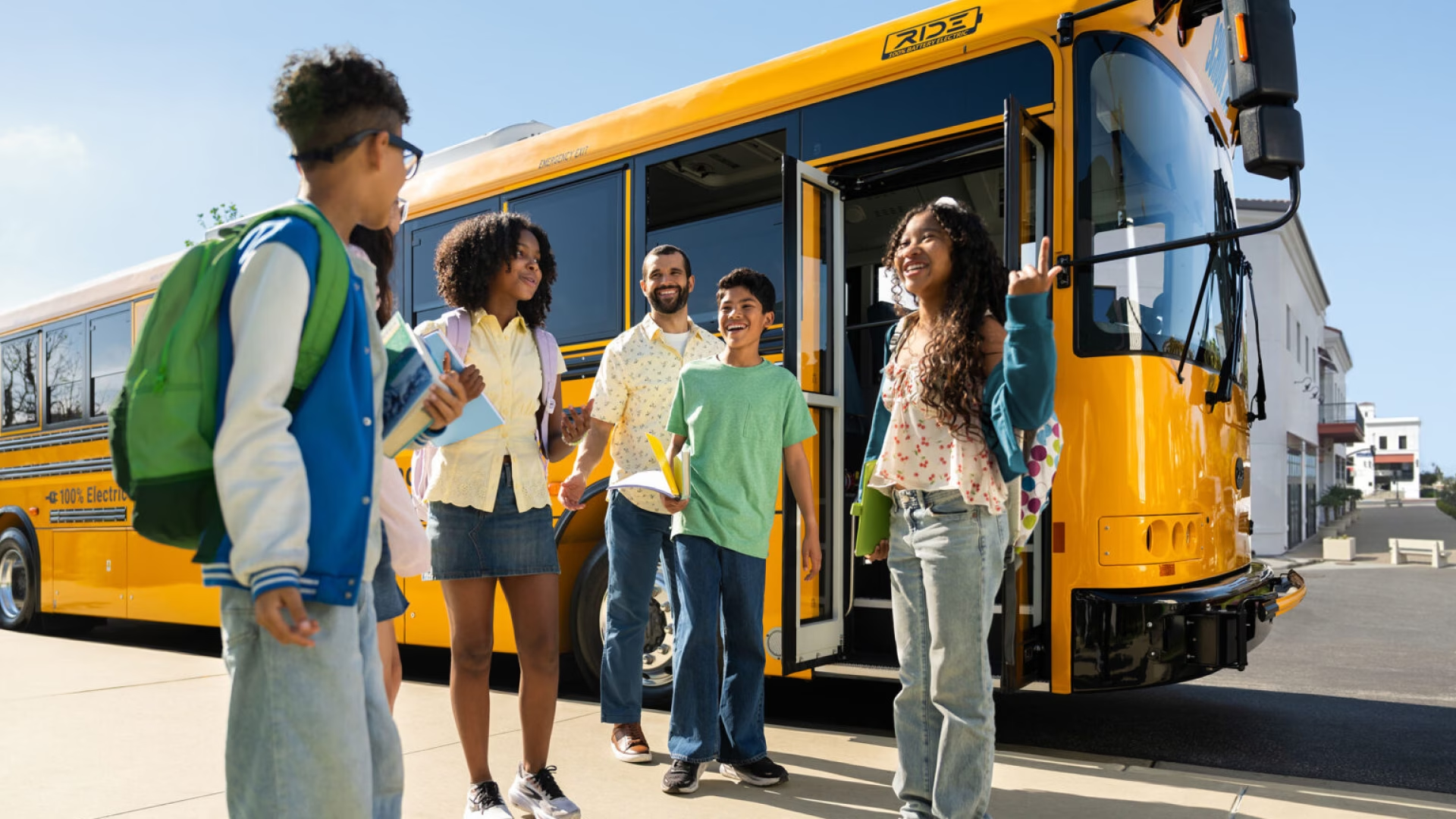
Children are in a constant state of learning–absorbing their surroundings which shape their perspective of what’s possible. Before the administrator, before the teacher, before they enter the classroom — there's the ride to school. And for too long, that experience has communicated the wrong thing. Unreliable buses, anxious parents and students, zero visibility for administrators. It's an early lesson in whether systems can be trusted.
What excites me about Zum's work is that we're rewriting that lesson. When a student boards a safe, modern, tech-enabled bus — when their parent gets a real-time notification, when the driver knows their name — that child receives something more valuable than a bus ride, they receive the foundation to realize aspirations and achieve their goals. When systems are connected and executed well, I believe this is what sparks the future engineers, educators, doctors, policymakers, and civic leaders of tomorrow.